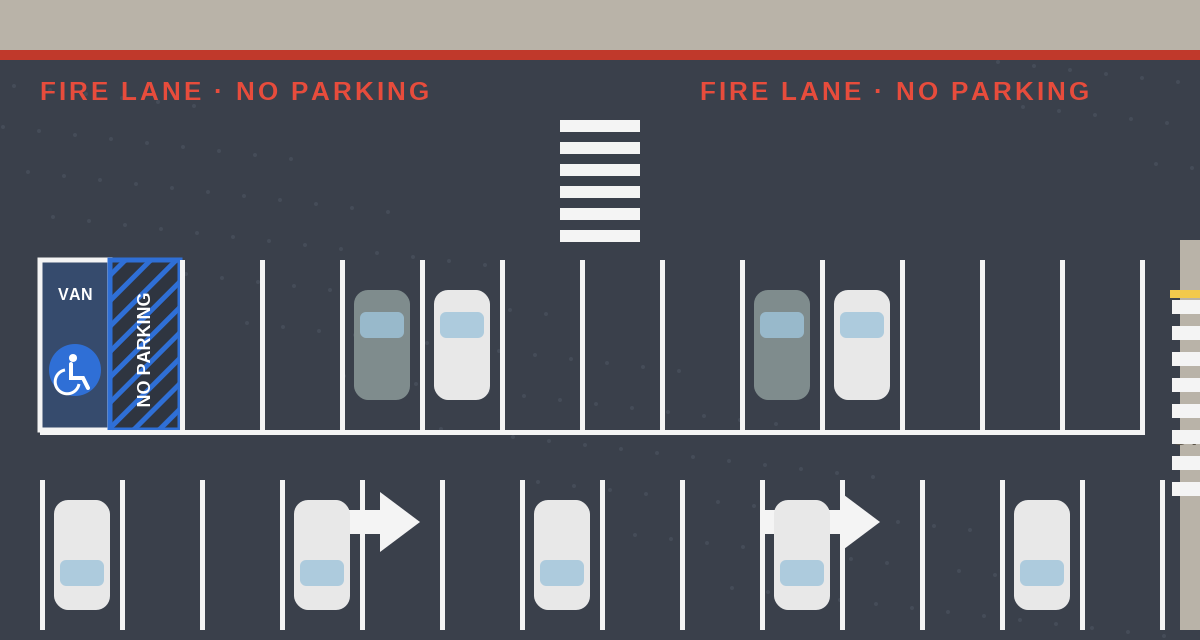
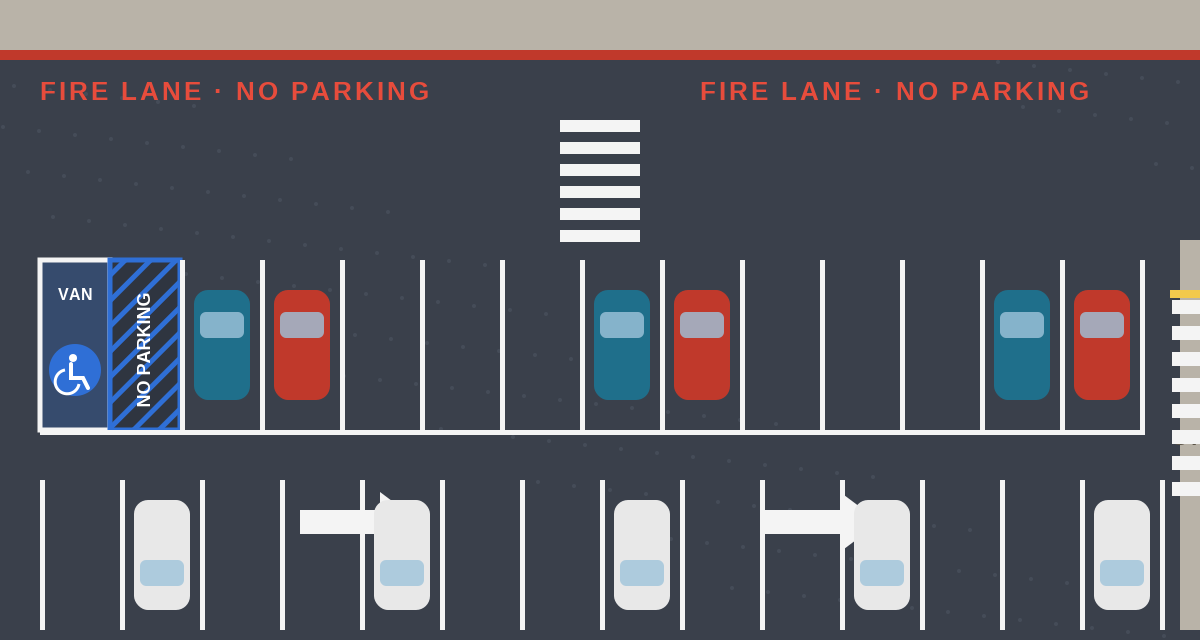
Dallas Painting provides parking lot striping in Parker County for shopping centers, apartments, offices, schools, churches, hospitals, warehouses, gas stations, restaurants and HOAs. Fresh, bright lines make a lot safer and easier to use, help you meet accessibility rules, and make the whole property look better maintained. We restripe existing layouts, lay out new lots, paint ADA stalls and symbols, mark fire lanes and curbs, and stencil arrows, numbers and words.
Parking lot striping services in Parker County
- Restriping: repainting existing lines, stalls and symbols on the same layout
- New layout: designing and marking a new stall plan after paving, sealcoating or a change of use
- ADA parking: accessible stalls, access aisles, International Symbol of Accessibility and van-accessible spaces
- Fire lanes: red curbs and FIRE LANE / NO PARKING lettering to your local fire code
- Curb painting: red, yellow and blue curbs, loading zones and bollards
- Arrows and stencils: directional arrows, STOP bars, stall numbers, reserved and EV spaces
- Crosswalks: continental and ladder crosswalks and pedestrian walkways
- Warehouse floor striping: aisle lines, forklift lanes, pedestrian walkways and safety markings
- Line removal: grinding or blacking out old lines when a layout changes
ADA parking requirements
Under the 2010 ADA Standards, which Texas follows through the Texas Accessibility Standards, the number of accessible spaces a lot needs depends on the total number of spaces. At least one of every six accessible spaces must be van-accessible, with a wider access aisle. Accessible spaces should be on the shortest accessible route to the entrance.
| Total spaces in the lot | Minimum accessible spaces |
|---|---|
| 1 to 25 | 1 |
| 26 to 50 | 2 |
| 51 to 75 | 3 |
| 76 to 100 | 4 |
| 101 to 150 | 5 |
| 151 to 200 | 6 |
| 201 to 300 | 7 |
| 301 to 400 | 8 |
| 401 to 500 | 9 |
| 501 to 1,000 | 2% of total |
| 1,001 and over | 20, plus 1 for each 100 over 1,000 |
We mark accessible stalls, access aisles with diagonal hatching and the accessibility symbol. Signs, slopes and ramps are part of compliance too; we'll point out anything we notice, and your architect or accessibility specialist can confirm the full requirements for your site.
Paint and materials
Most lots are striped with fast-drying waterborne traffic paint, which is ready for cars within minutes in good weather. For high-traffic entrances, crosswalks and roads we can use more durable materials. Reflective glass beads can be added to improve visibility at night.
In North Texas, striping has to handle triple-digit heat, strong UV, spring hail and the occasional hard freeze. Sun and heat fade lines and soften asphalt, and rain and traffic wear them down. Most lots need restriping every 12 to 24 months, and busy retail and restaurant lots often need it every year.
Who we stripe for
We stripe for retail centers, grocery stores, gas stations, restaurants, apartments, HOAs, offices, medical facilities, schools, churches, hotels, warehouses and public facilities in and around Parker County.
Scheduling around your business
We plan striping when your lot is quiet, often overnight or early on weekend mornings. Large lots are done in sections so customers can still park. We blow off debris first so the paint bonds to the pavement.
Parking lot striping cost in Parker County
| Item | Typical range |
|---|---|
| Restripe, per standard stall | $4 to $7 |
| ADA stall with symbol and aisle | $85 to $150 each |
| Directional arrow or stencil | $25 to $45 each |
| Fire lane, per linear foot | $1 to $1 |
| 100-stall lot restripe (typical) | $740 to $1,300 |
Restriping an existing layout can be priced instantly in the quote form above. New layouts, line removal, sealcoating coordination and multi-site programs are quoted by a sales representative after a site visit or aerial review.
Our striping process
- Site review. We count stalls, check ADA spaces and fire lanes, and note any layout changes.
- Written quote. You get a clear price and a proposed date and time window.
- Prep. We blow off and clean the surface and set up cones and barricades.
- Layout and striping. Lines are measured, snapped and painted with a striping machine; symbols are stenciled.
- Cure and reopen. We reopen sections as paint dries and do a final walkthrough with you.
Parking lot layout basics
Stall size, angle and aisle width decide how many cars fit and how easily drivers move through the lot. A typical standard stall is around 9 by 18 feet. Ninety-degree parking needs wider two-way aisles, while 45 and 60 degree layouts work with one-way aisles. When a layout changes, we follow the approved site plan and local code.
- Standard, compact, motorcycle and EV charging stalls
- Van-accessible ADA stalls with 8 ft access aisles
- Loading zones, drop-off lanes and cart corrals
- Stop bars, crosswalks and pedestrian paths
- Reserved, visitor, tenant and numbered spaces
- Drive-thru lanes and stacking lanes
Striping, sealcoating and pavement care
New paint on a crumbling surface won't last. Before restriping we look at cracks, raveling and drainage problems. When sealcoating is planned, we schedule striping right after it cures and repaint the full layout, since the sealcoat covers every old line. Planning both together saves a second closure of the lot.
Fire lanes and curb markings
Fire lanes keep the route open for fire trucks and ambulances. Most Texas cities, including the jurisdictions around Parker County, require red curbs or red stripes along the fire lane with FIRE LANE or NO PARKING lettering at set intervals, and the exact wording, letter height and spacing come from the local fire code. We paint fire lanes to the requirements your fire marshal gives you and keep the lettering crisp and readable.
Warehouse and industrial floor striping
Floor striping in warehouses and plants is about safety and efficiency. We mark forklift travel lanes, pedestrian aisles, pallet staging boxes, dock approach lines and keep-clear zones in front of panels, eyewash stations and exits. Coatings are chosen for concrete and for the traffic your floor sees, and work is scheduled between shifts or over weekends.
Small lots, big lots and everything in between
We handle everything from a small office lot with a dozen spaces to shopping centers, distribution yards and school campuses with hundreds of stalls, bus lanes and drop-off loops. Owners and managers with several properties across North Texas can put all of them on one restriping program with one point of contact.
Why property managers choose us
Property managers, facility directors and business owners in Parker County want a striping contractor who answers the phone, shows up on the scheduled night and leaves straight, clean lines. We give a firm price, confirm the date and work window, and send photos when the job is done. If you also need the building painted, curbs and bollards refreshed or a warehouse floor marked, one company can handle it all.
Parking lot striping near Parker County
We also stripe parking lots in Weatherford, Aledo, Willow Park, Hudson Oaks and Springtown and across North Texas.
- Parking lot striping in Weatherford→
- Parking lot striping in Aledo→
- Parking lot striping in Willow Park→
- Parking lot striping in Hudson Oaks→
- Parking lot striping in Springtown→
- Parking lot striping in Annetta→
- Parking lot striping in Reno→
Frequently asked questions
How often should a parking lot be restriped?
Most lots need restriping every 12 to 24 months. Busy retail and restaurant lots, and lots that were recently sealcoated, may need it more often.
How long before cars can drive on new lines?
In warm, dry weather, waterborne traffic paint is usually ready in 15 to 30 minutes.
Can you restripe without closing our business?
Yes. We work overnight or in sections with cones and barricades.
Do you mark ADA parking and fire lanes?
Yes. We paint accessible stalls, access aisles, symbols, red fire-lane curbs and lettering.
Do you stripe warehouse floors?
Yes. We mark forklift lanes, pedestrian walkways, aisles and safety zones.
Can you stripe after sealcoating?
Yes. We coordinate with your paving or sealcoating contractor and stripe once the surface has cured.